
by Hazel & Green
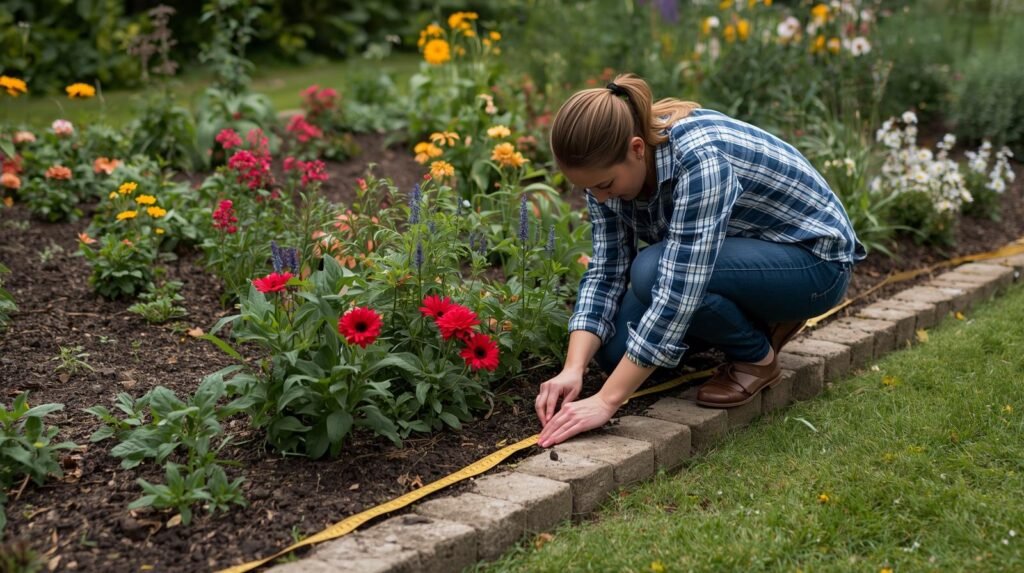
Whether you’re planning a new planting scheme, ordering edging, or creating a bespoke border design, accurate measurements make all the difference.
Here’s our simple step-by-step guide to measuring your garden border like a pro.
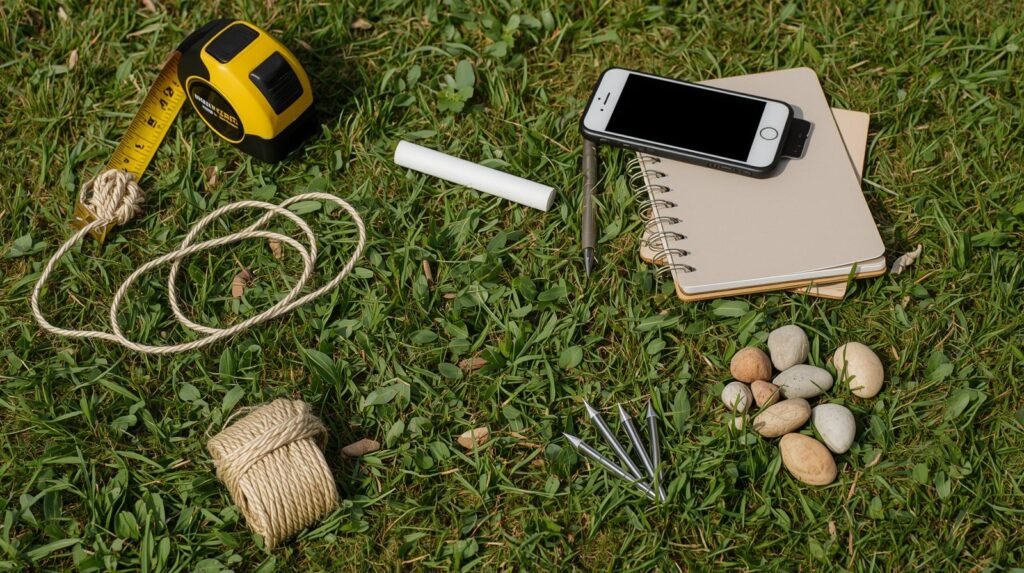
What You’ll Need
- A tape measure (ideally 5 m + long)
- Garden string or a flexible hose (to mark curves)
- Chalk, pegs, or small stones for marking
- A notebook or phone to record your measurements
- Optional: a helper for long or uneven borders
Step-by-Step Instructions
1️⃣ Mark Out the Shape
Lay a piece of string, garden hose, or twine along the edge where you want your border to be.
- For straight borders, run the string taut between two points.
- For curved borders, gently shape the hose or string to match your desired line.
This helps you visualise the shape before taking any measurements.
2️⃣ Measure the Length
Follow the string or hose with your tape measure and note the total length.
- Measure along the outer edge of the planned border.
- If the border has sections or changes direction, measure each part separately and add them together.
💡 Tip: For irregular shapes, break the curve into smaller straight sections — it’s easier to measure accurately that way.
3️⃣ Measure the Width (Depth)
At several points along the border, measure from the lawn edge or path into the border.
- Take at least three width measurements (start, middle, end) to check for consistency.
- If the border tapers or widens, note those differences.
Write each width down — this helps when planning plant spacing or ordering edging materials.
4️⃣ Sketch It Out
If you have an uneven border shape wise you can make a quick sketch showing the shape, length, and widths you measured.
Label each measurement clearly — this becomes your border plan. There is a section within the Border Design Questionnaire where this can be uploaded.
If you’re sending your details to us for design or planting advice, a photo of this sketch is perfect.
5️⃣ Check the Ground
Before finalising, take note of:
- Curves or slopes — does the ground rise or fall?
- Fixed features — trees, paths, sheds, fences.
- Access points — for maintenance or irrigation.
A few quick notes here make future planting easier.
Measuring Summary
| Border type | How to measure | Example |
| Straight | Tape measure along the full length | Fence line or pathway edge |
| Curved | Use flexible hose/string, then measure its path | Flower bed with gentle sweep |
| Irregular | Break into smaller segments and add up | Natural or organic-shaped border |
Final Tip from Hazel & Green
Always round up slightly (by 5–10 cm) when ordering materials — it’s better to have a little extra than to come up short once you start planting!