
Dream Catcher Garden – Hazel & Green
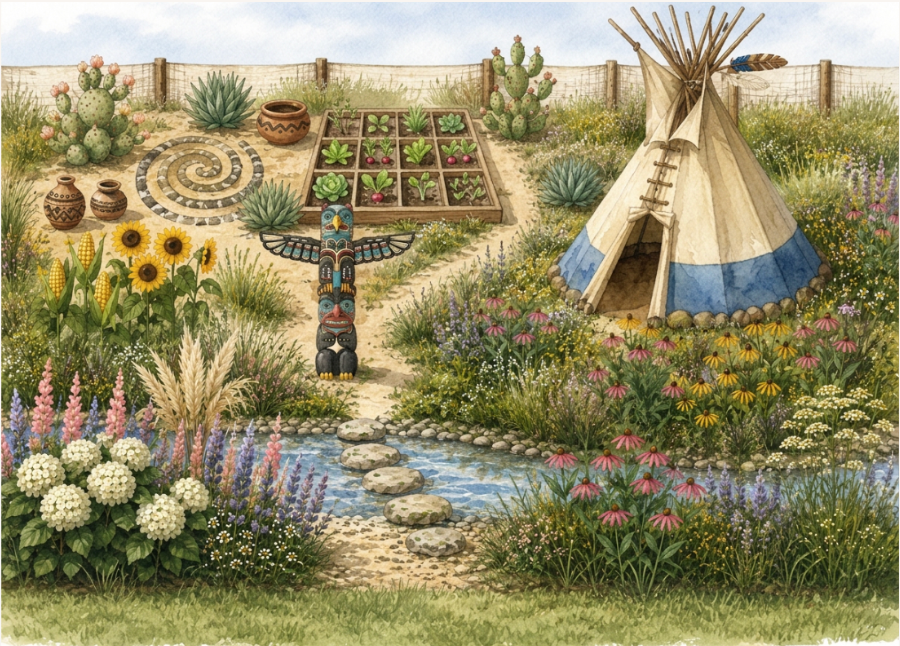
The Dream Catcher Garden
The Dream Catcher Garden explores how traditional Native American planting practices can help address challenges faced by modern UK gardeners.
Drawing inspiration from the diverse landscapes of North America, the garden demonstrates practical approaches to water conservation, drought resilience, biodiversity, soil improvement and sustainable food production.
Visitors will discover techniques including companion planting, prairie-style planting and water-wise garden design, adapted to help gardens thrive in an increasingly unpredictable climate.
The garden travels through several very different North American landscapes and draws upon the knowledge and traditions of different Indigenous peoples. These cultures and practices are distinct, and the garden aims to celebrate this diversity while exploring what gardeners today can learn from generations of people who understood how to work with their local environment.
The Great Plains Prairie
The prairie represents the vast grasslands of North America – landscapes shaped by sun, wind, grazing, seasonal drought and fire.
Rather than relying on large numbers of shrubs or trees, prairie landscapes are dominated by grasses and flowering herbaceous plants growing together in interconnected communities.
Many prairie plants develop extensive root systems, allowing them to reach moisture deeper within the soil and survive periods of drought. These roots also help hold soil together, improve its structure and return organic matter to the ground as they naturally die and regenerate.
Plants in Our Prairie
The prairie within The Dream Catcher Garden contains a mixture of ornamental grasses and flowering perennials including:
- Echinacea – Coneflower
- Rudbeckia – Black-eyed Susan
- Achillea – Yarrow
- Asters
- Monarda – Bee Balm
- Verbena bonariensis
- Miscanthus
- Panicum – Switchgrass
- Molinia
- Stipa tenuissima
The planting has deliberately been mixed rather than arranged in rigid blocks. Grasses weave through flowering plants, creating layers of different heights, textures and movement.
Flowers including Echinacea, Rudbeckia, Monarda and asters provide long periods of colour and valuable sources of nectar and pollen for insects, while grasses provide structure, movement and shelter.
Seed heads can remain standing after flowering, continuing to provide food and habitat while creating winter interest.
What Can UK Gardeners Learn from the Prairie?
Prairie-style planting is particularly relevant as our climate changes.
By selecting plants capable of coping with periods of heat and reduced rainfall, we can create gardens that require less intensive watering while still supporting wildlife.
Dense planting also means less exposed soil. This can help reduce moisture loss and make it more difficult for weeds to establish.
Rather than cutting everything down as soon as summer ends, stems and seed heads can remain through autumn and winter, providing food, shelter and overwintering habitat for wildlife.
The prairie demonstrates that a resilient garden does not have to be sparse. It can be abundant, colourful, dynamic and full of life.
The Tipi – Living with the Landscape
The tipi is particularly associated with the Indigenous peoples of the Great Plains, including nations such as the Lakota, Cheyenne, Blackfoot and Plains Cree.
Its ingenious structure suited a way of life in which communities sometimes needed to move across enormous landscapes.
Long wooden poles formed a strong conical frame, traditionally covered with prepared animal hides and, later, canvas. The structure could be dismantled and transported before being erected again elsewhere.
Its conical form also made it remarkably practical. The shape provides strength against Plains winds, while an opening and adjustable smoke flaps allow smoke from a central fire to escape.
The tipi demonstrates a central theme of the garden: designing in response to the environment rather than trying to overcome it.
The Southwest
Moving into the Southwest, the landscape changes dramatically.
Inspired by the arid landscapes of Arizona, New Mexico and the wider American Southwest, this area explores how plants survive where water is scarce, temperatures can be extreme and rainfall may be unpredictable.
Plants growing in these environments have evolved some extraordinary strategies for conserving water.
Plants in Our Southwest Garden
The planting includes:
- Yucca
- Agave
- Puya
- Delosperma
- White Sage
- Festuca glauca – Blue Fescue
- Stipa tenuissima – Mexican Feather Grass
- Barrel cactus
- Blue Myrtle cactus
- other cacti and drought-tolerant plants
The planting is intentionally more widely spaced than the prairie. Areas of exposed red sand and earth are an important part of the design, reflecting the openness of desert and semi-desert landscapes.
Yucca and agave have tough leaves that help reduce water loss, while their root systems allow them to make use of limited moisture.
Cacti take water conservation even further. Their fleshy stems act as water stores, while leaves have been reduced to spines, dramatically reducing the surface area from which moisture can escape.
Plants such as Delosperma use succulent leaves to store water, while fine-leaved grasses can survive in conditions that would be difficult for many conventional garden plants.
The result is a landscape where plants do not simply tolerate drought – their entire structure reflects their relationship with water.
What Can UK Gardeners Learn from the Southwest?
We don’t need to recreate an Arizona desert in Britain to learn from these plants.
Hotter summers and longer dry periods mean that choosing plants according to the conditions we actually have is becoming increasingly important.
Drought-tolerant planting can reduce the amount of additional irrigation a garden needs, particularly when combined with good soil preparation and careful positioning.
The Southwest garden asks a simple question: instead of continually supplying more water, could we choose plants that naturally need less of it?
Hopi Waffle Garden
Developed by the Hopi people of the arid American Southwest, waffle gardening is an ingenious way of growing crops where rainfall is scarce and every drop of water matters.
Small square or rectangular planting basins are dug into the earth and surrounded by low ridges, creating a pattern resembling a waffle. Crops are planted within the depressions, where precious rainfall and run-off can collect around their roots rather than disappearing across the surface.
The surrounding earth also helps shelter young plants from drying winds and reduces the loss of moisture from the soil.
Benefits for gardeners today: Waffle gardens demonstrate how the shape of the land itself can be used to conserve water. The principle can be adapted to increasingly hot and dry UK summers by creating shallow planting basins around thirsty vegetables rather than allowing water to run away.
Navajo (Diné) Spiral Planting – Ha’oolmaaz
The Navajo (Diné) people developed sophisticated growing techniques to produce crops in the dry and challenging landscape of the American Southwest.
One traditional method of planting is known as ha’oolmaaz. Rather than planting a field entirely in straight rows, planting could begin at the centre and gradually spiral outwards. Traditional accounts describe this method being used for corn and distinguish it from row planting, known as ool’aad.
Diné growing traditions are deeply connected to the natural world. Corn in particular has enormous cultural and spiritual importance, and traditional practices incorporate knowledge passed between generations, including planting songs, prayers and ceremonies.
Water conservation is essential in this high-desert environment. Diné people developed techniques to make the most of limited rainfall, including planting corn deeply where moisture remains in the soil and creating small depressions around plants to help capture rainwater.
In The Dream Catcher Garden, we have taken the traditional principle of ha’oolmaaz and created a smaller raised spiral filled with useful and edible plants.
As the spiral rises, it creates different growing conditions. The upper sections are warmer and better drained, while the lower sections can retain more moisture.
For the modern gardener this maximises planting within a small footprint while creating different levels of sun, shade, drainage and moisture.
Mound Planting and the Three Sisters
Mound planting has been practised in different forms by many Indigenous peoples of North America, particularly for growing important food crops such as corn, beans and squash.
Rather than planting into completely flat ground, soil and organic materials are gathered into raised mounds or hills. These provide deeper growing areas for roots, can improve drainage and create different moisture and temperature conditions within the soil.
Mound planting is particularly associated with Indigenous companion-growing systems such as the Three Sisters, where corn, beans and squash are grown together.
The corn provides support for climbing beans, the beans help enrich the soil with nitrogen, and the broad squash leaves shade the ground, helping suppress weeds and reduce moisture loss.
The Modern Connection – Hügelkultur
A similar principle is widely used by gardeners today in a technique known as Hügelkultur, a German word meaning “mound culture” or “hill culture.”
Modern Hügelkultur beds are usually created by building a mound using logs, branches, plant material, compost and soil. As the woody material slowly decomposes, it holds moisture, adds organic matter and creates a rich growing environment.
In The Dream Catcher Garden, mound planting demonstrates how building upwards and using natural materials can create productive growing areas while making better use of water and resources.
Ollas – Watering Beneath the Soil
An olla (pronounced oy-ya) is an unglazed clay vessel used to store or deliver water.
Clay vessels have a long history among the Indigenous peoples of the American Southwest, although the word olla itself is Spanish and the history of using buried ollas specifically for irrigation is complex.
For irrigation, an unglazed clay pot is buried in the soil with its neck remaining above ground and then filled with water.
Because the clay is porous, moisture gradually moves through the walls of the vessel and directly into the surrounding soil. As the soil dries, water is drawn towards the roots of nearby plants.
This means water is delivered underground, where the plants need it, rather than onto the soil surface where much of it can be lost through evaporation or run-off.
For UK gardeners facing hotter, drier summers, ollas provide an interesting example of slow, targeted watering that can considerably reduce water waste.
Adobe – Building with the Earth
The Navajo Spiral, Hopi Waffle Garden and surrounding wall within The Dream Catcher Garden are made using adobe, reflecting one of the most recognisable natural building materials of the American Southwest.
Adobe is essentially an earth-building material, traditionally made from local soil or clay mixed with water and often fibrous material such as straw. It can be shaped by hand or formed into bricks and allowed to dry naturally in the sun.
Adobe construction has an especially important history among the Pueblo peoples of the Southwest. Buildings constructed from thick adobe walls are particularly well suited to the region’s climate, helping moderate extremes of heat and cold.
In our garden, adobe visually connects these growing areas to the earth from which the plants themselves grow.
It also demonstrates another important lesson in sustainability: using simple materials available within the local environment rather than relying upon heavily manufactured products.
Yucca – Nature’s Needle and Thread
Yucca was an incredibly valuable plant to many Indigenous peoples of the American Southwest. Rather than being grown simply for decoration, different parts of the plant could provide food, fibre, soap and useful materials for everyday life.
The long, tough leaves contain remarkably strong natural fibres. By processing and separating these fibres, Indigenous peoples created material that could be twisted, woven or braided into cordage, baskets, mats, sandals and other useful objects.
Yucca fibre was also used in the making and repair of clothing and footwear, including moccasins.
One of the most fascinating features of the plant is the sharp point at the end of some yucca leaves. The leaf can be carefully stripped back to expose its strong fibres while retaining the pointed tip, effectively creating a natural needle with its own thread attached.
It is a powerful example of understanding a plant completely – not simply how to grow it, but how its natural characteristics can be used resourcefully.
Zuni Painted Pottery
The Zuni people, or A:shiwi, are one of the Pueblo peoples of the American Southwest and have a long and highly developed tradition of pottery making.
Clay gathered from the surrounding landscape could be shaped into vessels and decorated with distinctive painted designs. Pottery had practical purposes, including the preparation and storage of food and water, while individual forms and designs could also carry cultural meaning.
The painted pots within our Southwest landscape represent the ability to transform one of the simplest natural resources – earth – into something both useful and beautiful.
Woven Baskets, Dried Corn and Chillies
Basket weaving has been practised by Indigenous peoples throughout North America, with different nations developing their own techniques, materials, shapes and patterns.
Depending upon the local environment, baskets could be made from willow, grasses, reeds, yucca and other plant fibres and used for collecting, carrying, preparing and storing food and seeds.
Food preservation was equally important.
Corn was one of the most important crops cultivated by Indigenous peoples of North America, particularly throughout the Southwest. Harvested corn could be dried so that it could be stored and used long after the growing season had ended. Seed from particularly successful plants could also be kept for planting the following year.
Chillies could similarly be dried for long-term storage.
The baskets, dried corn and hanging chillies within the garden therefore represent harvesting, preservation, seed saving and making seasonal abundance last throughout the year.
The Medicine Walk – From Water to Land
Beginning in the river and continuing out of the water and along the path, the Medicine Walk explores the extraordinary knowledge Indigenous peoples of North America developed about the plants growing around them.
Plants were understood not simply as decoration. They could provide food, medicine, fibres and materials, and knowledge of where plants grew, when they should be gathered and how they were prepared was passed from generation to generation.
The Medicine Walk begins with aquatic and marginal plants before moving onto medicinal plants of the land, demonstrating how useful plants could be found throughout the surrounding landscape.
Sweet Flag – Acorus calamus
Sweet flag grows naturally around wetlands, ponds and river margins and has a long history of traditional use among Indigenous peoples of North America.
Different peoples, including the Cree, Ojibwe (Chippewa), Lakota and other Plains and woodland communities, have documented traditions associated with sweet flag. The aromatic rhizome was traditionally prepared in different ways and has been recorded for complaints including toothache, headaches, colds, sore throats and digestive problems.
Duck Potato / Wapato – Sagittaria latifolia
Growing in shallow water, duck potato demonstrates that wetlands were also important sources of food.
Known as wapato in parts of North America, its underground tubers provided a valuable starchy food. It was particularly important to Indigenous peoples of the Pacific Northwest, including Chinookan-speaking peoples and other communities living around the Columbia River and surrounding wetlands.
The tubers could be gathered from the mud, often by loosening them with the feet so that they floated to the surface, before being cooked and eaten.
It demonstrates how a wetland could be understood not as wasted or unusable ground, but as a productive food landscape.
Pickerel Weed – Pontederia cordata
Pickerel weed grows along the shallow edges of ponds, lakes and slow-moving waterways.
The plant was used as a food source by a number of Indigenous peoples of eastern North America. Its seeds could be collected and eaten, while young parts of the plant were also used as food.
Water Plantain – Alisma plantago-aquatica
Water plantain is another plant of shallow water and wet ground.
Species of Alisma have a history of traditional medicinal use in different cultures. Within the Medicine Walk it helps represent the transition between water, wetland and dry land, showing how plants growing in very different habitats could form part of people’s knowledge of their environment.
From the Water to the Land
As the Medicine Walk leaves the river and follows the path, the planting changes from aquatic species to plants traditionally valued for medicinal, practical and cultural purposes.
Echinacea – Purple Coneflower
Different species of Echinacea were traditionally used by a number of Plains peoples, including the Lakota, Cheyenne, Pawnee, Kiowa and Omaha.
Recorded traditional uses include preparations for toothache and other oral complaints, sore throats, wounds, infections and snake bites.
Echinacea later became widely adopted into commercial herbal medicine and remains one of the most recognisable examples of a North American plant whose traditional Indigenous uses influenced modern herbalism.
Yarrow – Achillea millefolium
Yarrow was known and used by numerous Indigenous peoples across North America, including the Navajo (Diné), Cherokee, Cheyenne and other communities.
Its leaves and flowers were traditionally prepared in different ways for wounds, bleeding, fever, colds, headaches and digestive complaints.
Skullcap – Scutellaria laterifolia
American skullcap is native to North America and has a history of traditional plant use.
Different Indigenous communities used species of Scutellaria in preparations associated with women’s health, the kidneys, digestive complaints and other ailments.
It later became incorporated into North American herbal medicine, where skullcap became particularly associated with calming and nervous-system preparations.
Goldenrod – Solidago canadensis
Goldenrod was used by numerous Indigenous peoples, with different communities developing their own preparations and uses.
Traditional uses recorded for Solidago species include preparations for wounds and sores, fevers, sore throats and digestive or urinary complaints.
Its flowers are also an excellent late-season food source for bees and other pollinating insects.
Wild Strawberry – Fragaria vesca
Wild strawberries and related native strawberry species were valued as both food and medicine by Indigenous peoples.
Different communities used the fruit, leaves and roots in traditional preparations, including for digestive complaints.
Strawberries also held cultural significance for some peoples. Among the Haudenosaunee, for example, strawberries have an important relationship with thanksgiving, renewal and the seasonal cycle.
Catnip – Nepeta cataria
Unlike many plants within the Medicine Walk, catnip is not native to North America. It originated in Europe and Asia and arrived with European settlers.
It was subsequently incorporated into North American herbal traditions and was used in preparations associated with complaints such as colds, fevers and digestion.
Its presence demonstrates another important aspect of plant knowledge: traditions are not frozen in time. People encounter new plants, learn their properties and incorporate useful species into existing practices.
Arnica – Arnica chamissonis
Native North American species of arnica have a long history of traditional use.
Different Indigenous peoples used arnica externally in preparations for bruises, swellings, sprains and muscular aches.
Today arnica remains familiar as an ingredient in commercially produced creams and gels for bruising.
Viper’s Bugloss – Echium vulgare
Viper’s bugloss is native to Europe and western Asia rather than North America, so it is not presented within the garden as an ancient Native American medicinal plant.
Its inclusion helps illustrate how introduced plants can become part of changing landscapes and later herbal traditions.
For today’s gardener, its greatest value is ecological: its nectar-rich blue flowers are extremely attractive to bees and other pollinators.
Coltsfoot – Tussilago farfara
Coltsfoot also originated in Europe and Asia and was introduced to North America.
It has a long history in European herbal traditions, particularly in preparations associated with coughs and respiratory complaints, and subsequently became established across parts of North America.
A Living Pharmacy
The Medicine Walk demonstrates something much bigger than the individual uses of these plants.
For Indigenous peoples, understanding plants required close observation of the environment over generations: knowing where a plant grew, when it appeared, which part could be used and how it should be harvested or prepared.
The walk begins in water because useful plants did not exist only in cultivated beds. They were found in rivers, wetlands, prairies, woodlands and dry landscapes.
The Medicine Walk invites us to look at plants differently – not simply for their flowers or appearance, but as part of a much deeper relationship between people, plants and place.
The traditional uses described here are presented for historical and educational purposes and are not recommendations for medicinal use.
New England and Cape Cod
The garden now moves from the heat and exposed earth of the Southwest to a softer landscape inspired by the northeastern coast of the United States.
Cape Cod is characterised by sandy soils, coastal winds, dunes and grasses, while the wider New England landscape is famous for its changing seasons and lush summer planting.
Plants in Our New England Garden
The planting includes:
- Hydrangeas
- Asters
- Monarda
- Echinacea
- Rudbeckia
- Miscanthus and other ornamental grasses
White and green hydrangeas create the fuller, softer character associated with New England gardens, while asters, Monarda, Echinacea and Rudbeckia continue the connection with North American flowering plants.
Cape Cod – Planting the Dunes
The planting becomes simpler as it reaches the Cape Cod-inspired dunes.
Grasses are planted through the sandy landscape, their fine foliage moving naturally in the wind.
Coastal plants have to cope with wind, freely draining sandy soils, salt exposure and limited available moisture.
The grasses demonstrate the importance of vegetation in stabilising vulnerable landscapes. Their roots help bind loose soil and sand, while their foliage reduces the movement of material across the surface.
For UK gardeners, particularly those gardening near the coast, the lesson is simple: choose plants for the environment rather than continually trying to change the environment for the plants.
Crushed Shells – From Indigenous Shell Middens to Modern Garden Mulch
For thousands of years, coastal Indigenous peoples of North America lived closely with the resources provided by the sea.
Shellfish formed an important part of life for many coastal communities, and shells accumulated around settlements in large deposits that we now call shell middens.
These middens could contain shells alongside organic material, food remains and other evidence of everyday life. Over long periods, the shells – which are largely composed of calcium carbonate – also changed the characteristics of the soil around them, creating areas with higher calcium levels and more alkaline conditions.
In some places these shell-rich soils have continued to influence the plants growing there.
In The Dream Catcher Garden, we have deliberately used crushed seashells around plants and across parts of the landscape.
We are not suggesting that today’s technique of spreading processed crushed-shell mulch is an exact historic Indigenous gardening practice. Instead, the garden draws a connection between the historic presence of shell-rich ground around coastal Indigenous communities and the way gardeners can make use of this natural material today.
Crushed shells form a mineral mulch that can help:
- reduce moisture loss
- suppress some weed growth
- protect the soil surface
- create free-draining conditions
- reduce erosion and soil splash
- provide a long-lasting alternative to organic mulch
As shells slowly weather, they can contribute calcium to the soil and may gradually increase its alkalinity, making them particularly useful around plants that tolerate or prefer neutral, alkaline or calcium-rich conditions.
The shells used throughout our garden have been generously supplied by Shell on Earth, who transform waste whelk shells from the seafood industry into a beautiful and useful landscaping material.
Working With Nature
Many of the ideas demonstrated throughout The Dream Catcher Garden share one underlying principle: observe the environment, understand it and work with it rather than against it.
Saving Seed – Plants Adapted to Place
For Indigenous communities across North America, seed was far more than something planted for a single season. Seed was saved, protected, exchanged and passed from one generation to the next.
Indigenous peoples selected seed from plants that performed particularly well in their local environment – plants that survived drought, coped with local soils, resisted pests or produced a good harvest despite difficult conditions.
When this careful selection was repeated over generations, the plants themselves gradually became better suited to the particular soil, climate and growing conditions of that area. These locally adapted plant populations are often known today as landraces.
This was particularly important for tribes living in challenging environments such as the American Southwest, where generations of knowledge and seed selection produced varieties of corn, beans, squash and other crops capable of growing successfully with very limited rainfall.
Much of the seed we buy today, particularly F1 hybrid seed, has been bred to produce very uniform plants with predictable characteristics. F1 varieties can perform extremely well, but seed collected from them will not usually produce plants identical to their parents.
By contrast, gardeners can save seed from open-pollinated varieties, choosing seed from the healthiest and most successful plants each year.
Over successive generations, this gives us the opportunity to select plants that perform particularly well in our own soil, microclimate and growing conditions.
Instead of expecting every garden to suit the plant, we can gradually select plants that suit the garden.
Chop and Drop
“Chop and drop” is the modern name for a very simple principle: instead of removing all spent plant material from the garden, useful organic matter is returned directly to the soil.
Indigenous growing systems across North America traditionally worked closely with locally available natural materials and seasonal cycles rather than treating every fallen or finished plant as waste.
In our garden, selected plant material is cut and left around plants where it can gradually break down.
As it decomposes, it returns organic matter to the soil while covering and protecting the ground.
For gardeners today, chop and drop can reduce garden waste, suppress weeds, protect the soil from drying out, provide habitat for soil organisms and gradually return nutrients and organic matter to the earth.
It demonstrates a wonderfully simple idea: what grows in the garden can help feed the garden.
Right Plant, Right Place
Although the Prairie, Southwest and New England/Cape Cod areas look completely different, they share the same fundamental principle.
Plants survive because they are suited to the environments in which they grow.
Prairie plants cope with open landscapes, competition and periods of drought. Southwest plants conserve and store precious water. Coastal plants withstand wind, exposure and rapidly draining soils.
Rather than continually watering, feeding or altering our gardens to keep unsuitable plants alive, we can observe the conditions we already have and select plants that naturally thrive within them.
Right plant, right place means healthier plants, less water, fewer resources and ultimately a more resilient garden.
Stories, Culture and Craft
Throughout The Dream Catcher Garden, objects, structures and natural materials also help tell the story of the many different Indigenous peoples and landscapes of North America.
These features come from different regions and cultures and are not intended to suggest that there is one single Indigenous culture across North America.
Totem Pole – Stories Carved in Wood
Totem poles originate from the Indigenous peoples of the Northwest Coast, particularly nations including the Tlingit and Haida.
Traditionally carved from large trees such as western red cedar, totem poles are far more than decorative objects. Different poles can record family or clan ancestry, histories, important events and stories, or commemorate significant individuals.
The figures carved into them can represent animals, people and clan crests, with each element carrying meaning connected to the people who created the pole.
The totem pole within our garden represents the rich tradition of storytelling through natural materials.
Dream Catcher – The Inspiration for Our Garden
Dream catchers originate specifically with the Ojibwe (Anishinaabe) people and later became adopted and adapted by other Indigenous communities.
Traditionally constructed from a circular hoop with a woven web inside, the dream catcher is associated with protection, particularly during sleep.
The dream catcher gives its name to The Dream Catcher Garden, but here it also represents something broader: the passing of stories, skills, beliefs and knowledge between generations.
Using What the Landscape Provides
Different Indigenous peoples developed very different cultures, traditions and ways of living, but again and again we find remarkable knowledge of the resources available within their particular environment.
Earth became buildings and pottery.
Trees became homes, structures and carvings.
Plant fibres became baskets, cordage and clothing.
Crops became food, seed and stores for winter.
Plants became medicine.
And knowledge was passed from one generation to the next.
For gardeners today, there is an important lesson within that relationship: look closely at the environment you have, understand the resources it provides, and work with nature rather than continually trying to work against it.
Our Sponsors
The Dream Catcher Garden would not have been possible without the generous support of our sponsors.
We have deliberately worked with companies whose products complement the central message of the garden: working with nature, conserving precious resources, improving our soils and finding sustainable ways to grow.
Shell on Earth
We are delighted to have the support of Shell on Earth, a family-run business based in West Wales.
Shell on Earth takes waste whelk shells from the family’s seafood processing business and transforms them into a beautiful and useful material for gardens and landscaping.
Rather than allowing the shells to become waste, they are cleaned, crushed and repurposed for uses including garden paths, borders, mulching, drainage and decorative surfaces.
The company operates with a strong circular-economy approach. The whelks are locally caught using traditional pots, the meat is used as food, the shells are recycled for gardening and landscaping, and organic waste from the process is converted into green energy.
Within The Dream Catcher Garden, Shell on Earth’s crushed shells play an important role in creating our paths and coastal landscape as well as demonstrating their potential as a natural mineral mulch.
Their use fits perfectly with one of the garden’s central messages: look at the natural resources we already have, find ways to reuse them and waste as little as possible.
Dalefoot Composts
We are also incredibly grateful for the support of Dalefoot Composts, a family-run business producing sustainable, 100% peat-free compost in the Lake District.
Dalefoot’s composts are made using natural, renewable ingredients including British wool, bracken and comfrey and are approved by the Soil Association for organic growing.
Wool is particularly interesting within a garden concerned with water conservation. Its fibres are naturally hygroscopic, helping the growing medium hold onto moisture and reducing the frequency with which plants need to be watered.
The composts are also naturally nutrient-rich and designed to release nutrients gradually throughout the growing season.
Dalefoot’s approach has another important environmental benefit: protecting peatlands.
Peat bogs are extraordinary habitats and important stores of carbon. Choosing peat-free compost allows us to grow plants without contributing to the removal of peat from these valuable environments.
Throughout The Dream Catcher Garden, Dalefoot compost has been used to help establish plants across our different growing areas, from the productive Waffle Garden and Navajo Spiral to the prairie and other planted landscapes.
Their philosophy complements our own message beautifully: healthy, resilient gardens begin with healthy soil, and conserving water and protecting the environment can start beneath our feet.
With Our Thanks
A huge thank you to Shell on Earth and Dalefoot Composts for supporting The Dream Catcher Garden at Southport Flower Show 2026.
Their generosity has helped us create a garden that doesn’t simply talk about sustainability, but demonstrates it through the materials and growing methods used throughout the garden.
Thank you for helping us bring The Dream Catcher Garden to life.